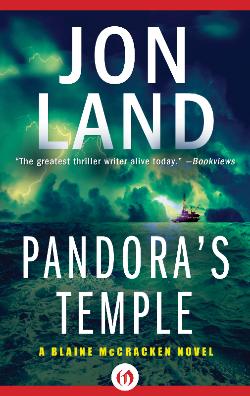
What if Pandora’s box was real. That’s the question facing Former Special Forces commando and rogue agent Blaine McCracken who returns from a 15-year absence from the page in his tenth adventure.
McCracken has never been shy about answering the call, and this time it comes in the aftermath of deepwater oilrig disaster that claims the life of a one-time mem-ber of his commando unit. The remnants of the rig and its missing crew lead him to the inescapable conclusion that one of the most mysterious and deadly forces in the Universe is to blame—dark matter, both a limitless source of potential energy and a weapon with unimaginable destructive capabilities.
Joining forces again with his trusty sidekick Johnny Wareagle, McCracken races to stop both an all-powerful energy magnate and the leader of a Japanese dooms-day cult from finding the dark matter they seek for entirely different, yet equally dangerous, reasons. Ultimately, that race will take him not only across the world, but also across time and history to the birth of an ancient legend that may not have been a legend at all. The truth lies 4,000 years in the past and the construction of the greatest structure known to man at the time:
Pandora’s Temple, built to safeguard the most powerful weapon man would ever know.
Now, with that very weapon having resurfaced, McCracken’s only hope to save the world is to find the temple, the very existence of which is shrouded in mystery and long lost to myth. Along the way, he and Johnny Wareagle find themselves up against Mexican drug gangs, killer robots, an army of professional assassins, and a legendary sea monster before reaching a mountaintop fortress where the fi-nal battle to preserve mankind will be fought.
The hero of nine previous bestselling thrillers, McCracken is used to the odds be-ing stacked against him, but this time the stakes have never been higher.
Jon Land is the critically acclaimed author of 32 books, including the bestselling series featuring Texas Ranger Caitlin Strong that includes STRONG ENOUGH TO DIE, STRONG JUSTICE, STRONG AT THE BREAK, STRONG VENGEANCE (July 2012) and STRONG RAIN FALLING (August 2013).
He has more recently brought his long-time series hero Blaine McCracken back to the page in PANDORA’S TEMPLE (November 2012). He lives in Providence, Rhode Island.
The Mediterranean Sea, 2008
“It would help, sir, if I knew what we were looking for,” Captain John J. Hightower of the Aurora said to the stranger he’d picked up on the island of Crete.
The stranger remained poised by the research ship’s deck rail, gazing out into the turbulent seas beyond. His long gray hair, dangling well past his shoulders in tangles and ringlets, was damp with sea spray, left to the whims of the wind.
“Sir?” Hightower prodded again.
The stranger finally turned, chuckling. “You called me sir. That’s funny.”
“I was told you were a captain,” said Hightower
“In name only, my friend.”
“If I’m your friend,” Hightower said, “you should be able to tell me what’s so important that our current mission was scrapped to pick you up.”
Beyond them, the residue of a storm from the previous night kept the seas choppy with occasional frothy swells that rocked the Aurora even as she battled the stiff winds to keep her speed steady. Gray-black clouds swept across the sky, colored silver at the tips where the sun pushed itself forward enough to break through the thinner patches. Before long, Hightower could tell, those rays would win the battle to leave the day clear and bright with the seas growing calm. But that was hardly the case now.
“I like your name,” came the stranger’s airy response. Beneath the orange life jacket, he wore a Grateful Dead tie dye t-shirt and old leather vest that was fraying at the edges and missing all three of its buttons. So faded that the sun made it look gray in some patches and white in others. His eyes, a bit sleepy and almost drunken, had a playful glint about them. “I like anything with the word ‘high.’ You should rethink your policy about no smoking aboard the ship, if it’s for medicinal purposes only.”
“I will, if you explain what we’re looking for out here.”
“Out here” was the Mediterranean Sea where it looped around Greece’s ancient, rocky southern coastline. For four straight days now, the Aurora had been mapping the sea floor in detailed grids in search of something of unknown size, composition and origin; or, at least, known only by the man Hightower had mistakenly thought was a captain by rank. Hightower’s ship was a hydrographic survey vessel. At nearly thirty meters in length with a top speed of just under twenty-five knots, the Aurora had been commissioned just the previous year to fashion nautical charts to ensure safe navigation by military and civilian shipping, tasked with conducting seismic surveys of the seabed and underlying geology. A few times since her commission, the Aurora and her eight-person crew had been re-tasked for other forms of oceanographic research, but her high tech air cannons, capable of generating high-pressure shock waves to map the strata of the seabed, made her much more fit for more traditional assignments.
“How about I give you a hint?” the stranger said to Hightower. “It’s big.”
“How about I venture a guess?”
“Take your best shot, dude.”
“I know a military mission when I see one. I think you’re looking for a weapon.”
“Warm.”
“Something stuck in a ship or submarine. Maybe even a sunken wreck from years, even centuries ago.”
“Cold,” the man Hightower knew only as “Captain” told him. “Well, except for the centuries ago part. That’s blazing hot.”
Hightower pursed his lips, frustration getting the better of him. “So are we looking for a weapon or not?”
“Another hint, Captain High: only the most powerful ever known to man,” the stranger said with a wink. “A game changer of epic proportions for whoever finds it. Gotta make sure the bad guys don’t manage that before we do. Hey, did you know marijuana’s been approved to treat motion sickness?”
Hightower could only shake his head. “Look, I might not know exactly you’re looking for, but whatever it is, it’s not here. You’ve got us retracing our own steps, running hydrographs in areas we’ve already covered. Nothing ‘big,’ as you describe it, is down there.”
“I beg to differ, el Capitan.”
“Our depth sounders have picked up nothing, the underwater cameras we launched have picked up nothing, the ROVS have picked up nothing.”
“It’s there,” the stranger said with strange assurance, holding his thumb and index finger together against his lips as if smoking an imaginary joint.
“Where?”
“We’re missing something, el Capitan. When I figure out what it is, I’ll let you know.”
Before Hightower could respond, the seas shook violently. On deck it felt as if something had tried to suck the ship underwater, only to spit it up again. Then a rumbling continued, thrashing the Aurora from side to side like a toy boat in a bathtub. Hightower finally recovered his breath just as the rumbling ceased, leaving an eerie calm over the sea suddenly devoid of waves and wind for the first time that morning.
“This can’t be good,” said the stranger, tightening the straps on his life vest.
* * *
The ship’s pilot, a young, thick-haired Greek named Papadopoulos, looked up from the nest of LED readouts and computer-operated controls on the panel before him, as Hightower entered the bridge.
“Captain,” he said wide-eyed, his voice high and almost screeching, “seismic centers in Ankara, Cairo and Athens are all reporting a sub-sea earthquake measuring just over six on the scale.”
“What’s the epi?”
“Forty miles northeast of Crete and thirty from our current position,” Papadopoulos said anxiously, a patch of hair dropping over his forehead.
“Jesus Christ,” muttered Hightower.
“Tsunami warning is high,” Papadopoulos continued, even as Hightower formed the thought himself.
“Whoa, whoa, whoa, we are in for the ride of our lives!” blared the stranger, pulling on the tabs that inflated his life vest with a soft popping sound. “If I sound excited it’s ‘cause I’m terrified, dudes!”
“Bring us about,” the captain ordered. “Hard back to the Port of Piraeus at all the speed you can muster.”
“Yes, sir!”
Suddenly the bank of screens depicting the seafloor in a quarter mile radius directly beneath them sprang to life. Readings flew across accompanying monitors, orientations and graphic depictions of whatever the Aurora’s hydrographic equipment and underwater cameras had located appearing in real time before Hightower’s already wide eyes.
“What the hell is—“
“Found it!” said the stranger before the ship’s captain could finish.
“Found what?” followed Hightower immediately. “This is impossible. We’ve already been over this area. There was nothing down there.”
“Earthquake must’ve changed that in a big way, el Capitan. I hope you’re recording all this.”
“There’s nothing to record. It’s a blip, an echo, a mistake.”
“Or exactly what I came out here to find. Big as life to prove all the doubters wrong.”
“Doubters?”
“Of the impossible.”
“That’s what you brought us out here for, a fool’s errand?”
“Not anymore.”
The stranger watched as a central screen mounted beneath the others continued to form a shape massive in scale, an animated depiction extrapolated from all the data being processed in real time.
“Wait a minute, is that a . . . It looks like— My God, it’s some kind of structure!“
“You bet!”
“Intact at that depth? Impossible! No, this is all wrong.”
“Hardly, el Capitan.”
“Check the readouts, sir. According to the depth gauge, your structure’s located five hundred feet beneath the seafloor. Where I come from, they call that impos—“
Hightower’s thought ended when the Aurora seemed to buckle, as if it had hit a roller coaster-like dip in the sea. The sensation was eerily akin to floating, the entire ship in the midst of an out-of-body experience, leaving Hightower feeling weightless and light-headed.
“Better fasten your seatbelts, dudes,” said the stranger, eyes fastened through the bridge windows at something that looked like a waterfall pluming on the ship’s aft side.
Hightower had been at sea often and long enough to know this to be a gentle illusion belying something much more vast and terrible: in this case, a giant wave of froth that gained height as it crystallized in shape. It was accompanied by a thrashing sound that shook the Aurora as it built in volume and pitch, felt by the bridge’s occupants at their very cores like needles digging into their spines.
“Hard about!” Hightower ordered Papadopoulos. “Steer us into it!”
It was, he knew, the ship’s only chance for survival, or would have been, had the next moments not shown the great wave turning the world dark as it reared up before them. The Aurora suddenly seemed to lift into the air, climbing halfway up the height of the monster wave from a calm sea that had begun to churn mercilessly in an instant. A vast black shadow enveloped the ship in the same moment intense pressure pinned the occupants of the bridge to their chairs or left them feeling as if their feet were glued to the floor. Then there was nothing but an airless abyss dragging darkness behind it.
“Far out, man!” Hightower heard the stranger blare in the last moment before the void claimed him.
If you’re looking for a thriller with a break-neck pace then this could be the book for you. It has everything from unexplained natural phenomena to giant undersea creatures; and megalomaniac industrialists to suicidal Japanese fanatics. There are even some eco-terrorists and crazy gun-toting robots thrown in for good measure.
Blaine McCracken is the hero of this story; he’s a former Special Forces commando, who’s once again answering his country’s call to help. He carries a sense of vulnerability from a previous mission that wasn’t totally successful but is basically a strong, sound character, who with the other principle characters paints the believable cast. I particularly liked Wareagle, and the just plain crazy, Captain Seven who complimented their fellow adventurers.
At times, some of the action pushed the believability threshold a little, but the author kept things within the realms of possibility and scientific fact without going too far. The action when it came was swift and credible, and felt authentic; with good attention to detail where it mattered.
There are plenty of Blaine McCracken adventures to read, but this one stands alone well, and there’s enough detail that means you don’t need to read them in order and can easily start with this one if you wanted to.
Pandora’s Temple is an entertaining read, and perfect for when you need a book to let you escape your own world for a bit. Come and join Blaine McCracken and his companions on a non-stop adventure.
The author has very kindly offered an e-book version of one of his previous novels The Omega Command. If you’d like a chance to win this, please leave a comment to this post below. Please state the e-book type you would like in your comment e.g. kindle, nook etc.
Thanks to Jon Land for his generosity.

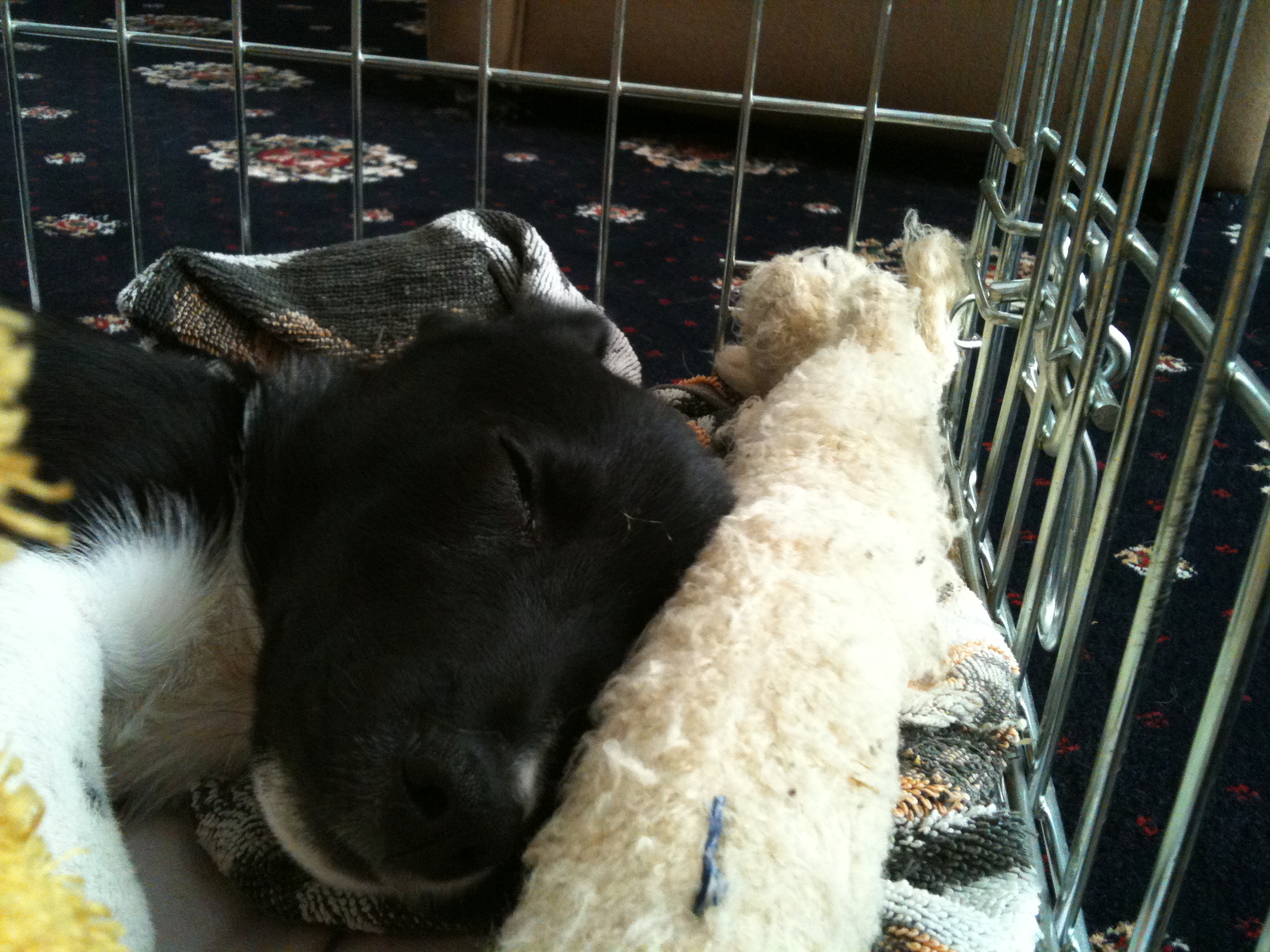 I got used to my new life really quickly and actually quite liked the cage that I had to sleep in, particularly because it had lots of toys, blankets and cushions and so was really comfortable.
 I loved being out in the garden, there was so much to see and do, and I was always able to find things to keep me occupied. I did however have one small incident, which I think got blown out of all proportion.
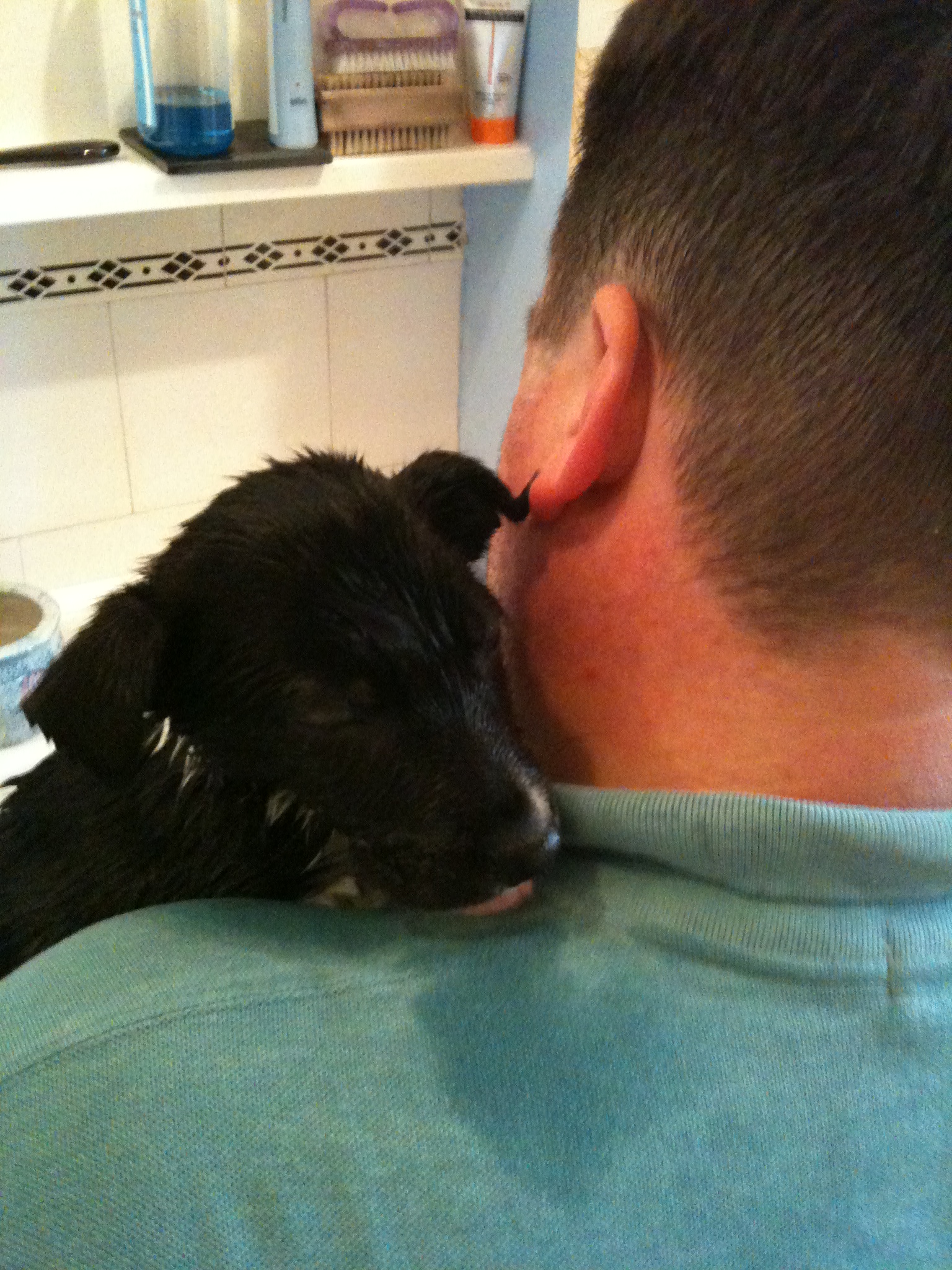 Not just once though, but twice because Alan made me have something called a bath, and he washed off all of the weed and the smelly mud with something called shampoo, in the bathroom sink.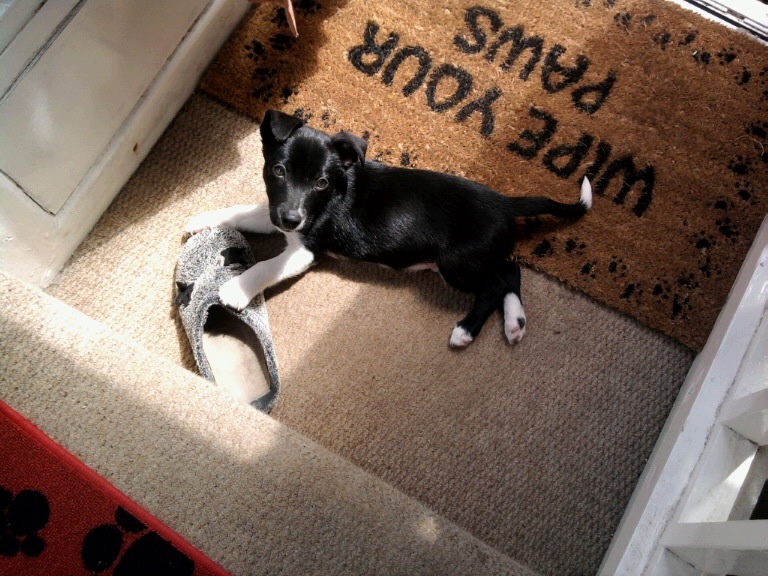




 Electronic Scrapbook