
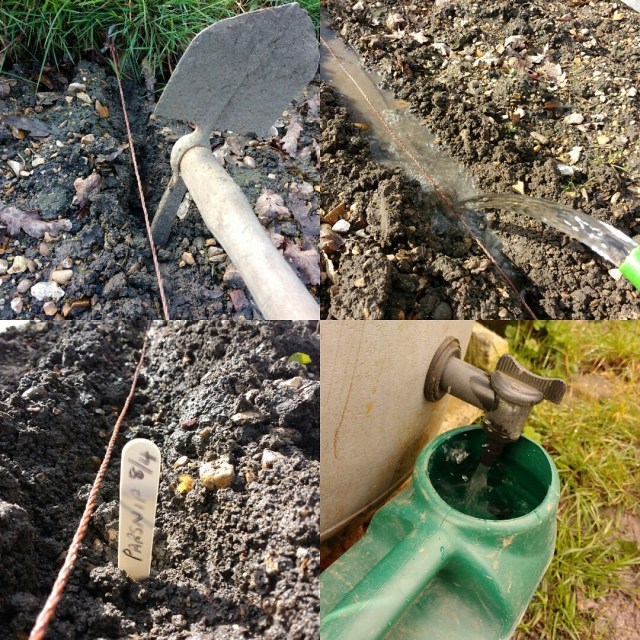
Sowing Seeds

IMG_20160409_112851

It’s that time of the year, when spring is arriving and the ground is warming up and it’s time to sow some seeds directly on the allotment. I thought it might be useful to share the method that I use. It works for me, on my allotment, but there are other hints and tips, and some seeds need to be sown in other ways, but generally speaking for pretty much everything that I sow from seed directly into the ground this is the method that I use. Last weekend I sowed parsnip, turnip and radish. Let me walk you through the sowing of the parsnips.
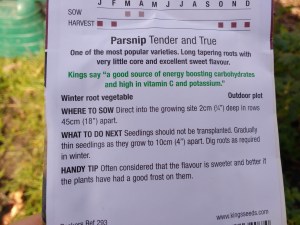
IMG_20160409_092754119Firstly, read the seed packet.

I know I said that I use the same method, and I do, but you need to check there is nothing special about the seed that you’re sowing. Some seeds come “coated”, which can irritate your skin, and it’s advisable to wear gloves.

More simply you want to make sure that you’re sowing your seeds at the right time, and that you space them correctly and know whether you’re going to need to thin them or any other ongoing care that you’ll need to provide once they’ve germinated.
IMG_20160409_092453082Next I mark out where I’m going to sow.

Normally this is a straight row. I use a line, pegged at either end to keep it taught, and to stop it moving around.

This helps me to keep the row straight during the next step, and also gives me a guide as to where the seed is going. It doesn’t have to be perfect, it’s only a guide!
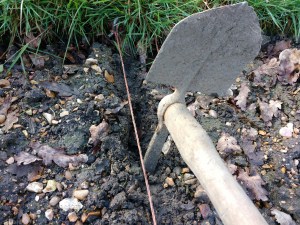
IMG_20160409_092530579I then run the narrow end of my adze alongside the line to create a drill.

I’ve had this tool for a while, and it was given to me by someone who couldn’t find a use for it. It’s perfect for this job, and depending on how deep or wide I need the drill to be, I’ll use one end or the other. For the parsnips I only need a narrow, shallow drill so I used the smaller, narrower end.

IMG_20160409_092922116Once I’ve made my drill, I water it.

I do this before the seeds go in. This means that the seeds are going onto slightly damp soil, which stops them from blowing out of the drill if it’s windy, and also aids germination.

I’ll still water them again when the seeds are sown, this is a pre-sowing water.
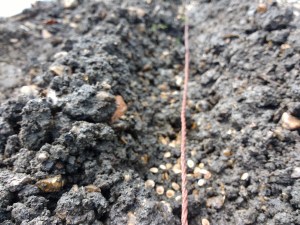
IMG_20160409_093250081Next I’ll sow the seeds, following the seeds, following the packet instructions, but also using my own experience and knowledge.

As these are parsnips I tend to sow more densely than recommended, because germination is notoriously poor with most varieties of parsnips. If they go the other way, and they all come up, then I’ll have more thinning out to do later, but that is preferable to having more germination or patchy rows taking up a lot of space for very few plants.
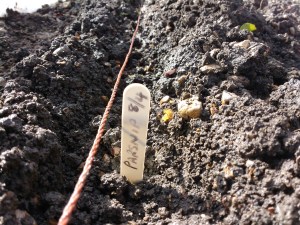
IMG_20160409_093422269Finally I’ll mark the row at each end, with the seed type and the date. I also keep a record of what I’ve sown when in my notebook, just so I can keep an eye on when things should start to appear.

Then I’ll remove the line, backfill the drill by scraping the soil back over with a rake, and water covered-over drill well. I’ll do this even if rain is forecast, as often forecasts are wrong.

That’s it. Simple. On to the next row, and next seed type.

Do you have any tried and tested methods that work for you? If so leave me a comment below, I’d like to hear what they are and maybe try them myself.


First Quarter Review 2016

Each year for the past few years I’ve been doing a year end review; books I’ve read, films/tv programmes I’ve watched and other things related to work and the allotment. You can read the end of 2015 here, if you’re interested.

The problem I have is trying to remember stuff (that might be an age thing). I guess that the things that were really good, tend to stick in my mind, as they should, but some of the things that were okay but not outstanding, tend to get forgotten.

So I thought I’d try doing a quick review of each quarter of the year, during 2016; rather than trying to remember everything in December. We’ll see how it goes, and hopefully I’ll remember to do ones at the end of June and September!

Work

Last year I went from being an employee to being self-employed. It was a significant moment for me, and started out well. Although the first three months of this year have been quieter than the tail end of last year, there’s still be a steady flow of work and this has also allowed me to think about goal setting for the year, and also work on some other projects. I don’t want to talk about those other projects at the moment, except to say that they focus more on the allotment / growing / fork-to-fork side of things, and although they are unlikely to make me rich (not that I ever particularly want to be rich), I hope that they might eventually generate some income, and perhaps give me a better quality more sustainable lifestyle. We’ll see.

I’ve also started much more consciously sharing my work side, posts on this blog like the Quick Links that are appearing on Tuesdays, and some new pages are a step in that direction. If anyone has any feedback on those things or any questions, then do please leave a comment below.

Allotment

As you might expect the tale end of winter is a quiet time on the allotment, and although we’ve been continuing to harvest brassicas, leeks and a few other small things, not much has really been happening, apart from the bits that link to work (see above), and I hope I’ll be able to share more on that in due course.

Things are starting to pick up now though, as the weather gets warmer and heats up the soil, the risk of frost decreases and the days get longer. Soon things will be in full swing. I’m looking forward to what I hope will be a good, productive year.

Books

So far I seem to have managed to read 14 books in the past three months, which I am quite surprised about. You can see what I’ve been reading here. Of them, there are a couple that stand out for me. Colter by Rick Bass is one and The Road To Little Dribbling by Bill Bryson is the other. The latter speaks to me because it touches on some of the things that I feel are going wrong with this country, and without wishing to get too political here and now, it was refreshing to read that I am not alone with my thoughts and perceptions. The former of the two was by a new author to me, and I’ll say now if you have a problem with hunting for food, you might want to give this one a miss, as Colter is a German Short-haired Pointer that is the author’s hunting dog, and a lot of the book is devoted to hunts. With that caveat I’d recommend both.

Films & TV

A few things here. Firstly the second season of Bosch, has just aired on Amazon Prime. I mentioned the first season in my review of 2015, and I’m pleased it was commissioned for a second season, and hopefully there will be a third. Although it was only released at the beginning of the month, I have already managed to watch all ten episodes and loved it! I’d thoroughly recommend to anyone who likes crime drama

I’ve also watched the most recent Bond film – Spectre when it went to DVD, although I enjoyed it, I don’t really want to rave about it as it was okay, but not that outstanding. If I was writing this in December I probably wouldn’t even mention it.

A final mention though for A Walk in the Woods, adapted from Bill Bryson’s novel of the same name. Again another DVD watch, but one that I really enjoyed. My only criticism is that it came to a somewhat abrupt end, and was over before I felt it really got going. Robert Redford and Nick Nolte were excellent.

Life In General

Is pretty good I think; we managed to have our first holiday in about three years in March, another benefit of being my own boss now and not having to worry about the threat of being made redundant. I’m enjoying working from home, and setting my own goals and timetables. I have lots planned for this year, and things I want to get achieved. So far so good though, looks like I’m on course.

Allotment Update 26th March 2016

  
The weather has been much improved over the last few weeks, and it has continued to be very mild. I had hoped to be able to post a video update, but I’ve been having some rather odd camera trouble and none of the segments that I’ve recorded have been useable. I’m not sure what the problem is, but in the meantime I’ll try and describe what I’ve been up to .

I’ve planted my early potatoes (see above), they went in today (Easter Saturday), and all being well, they’ll be ready to harvest in 100 days, or at least that’s what folklore says, and it’s been right most times. I’m still a little concerned that we might get a frost. I’ve earthed them up well, and will continue to do so as the first aulms come through.

I also transplanted out the onion sets that were in modules in the potting shed. There were 96 originally, but some got waterlogged following a leaky roof, so only 50 actually went in the ground. They didn’t look as strong as the ones that have been in the ground all winter, probably a combination of the waterlogging and the mild winter for those outside.

The final round of planting for this weekend was to get some brassica plants in too; cabbages, cauliflowers and broccoli. They should be ready to harvest in the summer, all being well.

Finally, I’ll need some new boots before the winter – mine have split!


Otter Farm

UPDATE: The Otter Farm Crowdfunder reached it’s target, and will be funded. Thank you if you pledged.

As an allotment gardener, I’m sometimes asked why I grow my own veg and what I grow.

The answer to the second question is easy. I grow what I like to eat (with a little experimentation each year for new things). The answer to the first question is a little more complex. Let me try an explain.

I grow my own veg for a number of reasons. Firstly I like to try and be as self sufficient as possible, growing my own, means I cook with what I grow and am less reliant on supermarket produce, which is often days old and grown under standards (from the supermarket) which often lead to the waste of perfectly good food (see my post on wonky veg). I also preserve a lot for use over the winter.

Secondly I like to cook from scratch, take raw ingredients and turn them into something that (hopefully) is delicious, I use a lot of my allotment produce in this way and it means we don’t have huge amounts of processed foods and meals in our house.

Next up, it keeps me fit. I’m not a great one for gyms or sports, and I rarely run unless something big and scary that wants to eat me is chasing me! So the allotment; digging, planting, maintaining, harvesting is a big part of my exercise regime.

The allotment is also my tranquil place, where I can think, have some time for me, lead a simpler life and find an affinity with the values above.

Now that’s quite a bit of waffle but a bit of background for the video at the head of this post, if you haven’t watched it already go and do so now and the come back here. I’ll wait.

Mark Diacano owns and runs Otter Farm, and I find a lot of affinity with the values above with what he is trying to do there. He currently has a project, which aims to help people grow, cook, preserve, distill and understand their own food.

Okay so here’s the rub, this current venture is a crowdfunded project. Without the likes of me and you it won’t happen now, and maybe not ever. It looks tight. There are 5 days left and about 30% still to raise. I’ve backed it and I’m asking you to see if you will too? Watch the video above, look at the Otter Farm Website and if you feel inclined, go to the Crowdfunder page and pledge. If you don’t agree with me or can’t afford it, no problem and no pressure, but I want to make you aware of this project as the values are close to mine, and if you are able to support it, there are some great rewards.

If you’ve read this far, thank you. I realise this isn’t quite the usual post for this blog.

“What Mark’s been doing at Otter farm is inspirational. What he’s planning to is one of the most exciting things in British horticulture. I’m delighted to add my support to such a far-sighted and well-thought out project.”

Hugh Fearnley-Whittingstall

Chitting Potatoes

IMG_20160219_095324550
How Do You Chit Yours?

This has to be another sign that spring is on the way, the potatoes are out in their egg box holders chitting!

Why chit potatoes? Well simply when growing at a small scale (commercial potatoes farmers rarely chit potatoes, due to the space constraints), it helps the potatoes to get a little bit of a head start before they go into the ground. The aim is to encourage the potatoes to start to sprout, and ideally we’re looking for small (normally) dark purple sprouts. This is achieved by leaving the potatoes in the light at room temperature for a couple of weeks before planting.

I use cardboard egg boxes, as their ideal for supporting the potatoes, and preventing them from rolling around, and potentially damaging the sprouts that I’m trying to encourage. You can also use seed trays or seed modules – horses for courses folks, it’s whatever works for you!

As I mentioned in my video update (6th Feb) below, folklore says that normally you plant early potatoes at Easter and then harvest 100 days later. Now I’m using the term folklore advisedly here, because it certainly is good advice and last year proved exactly true. I planted my spuds on Easter Saturday and exactly 100 days later dug the first plant to an excellent crop!

This year Easter Saturday is the 26th March, which as I said in the video feels a little early given the potential for there still to be frost (our last predicted frost day is normally mid April, but again only a prediction), however having checked last year’s calendar, Easter Saturday 2015, was April 4th. So on that basis only 9 days later than it is this year. So perhaps not as early as I felt it was.

For now I’m not going to make any decisions either way. I’d certainly like to get my potatoes in the ground on Easter Saturday; as it feels like a milestone in the growing calendar. At the moment however, the ground is too wet, and the risk of them rotting in the ground is probably greater than any risk of frost, so there’ll need to be a dry spell between now and Easter anyway if that’s what I’m aiming for!

From Chitting to Planting (soon I hope)

Allotment Update 6th February 2016

I think this weekend was the first reasonable block of time that I’ve been able to spend on my allotment this year. We’ve had weeks of consistent rain, which has left the soil too damp to work without the fear of compacting it, so there has been a limit to the jobs that I’ve been able to get done. The mild temperatures however have meant that the weeds have continued to grow, and on some of the areas that I had already dug, they have been starting to show through. Spending some time weeding ahead of the forthcoming sowing of seeds was therefore important. If the weather holds mild, and dries up a bit more, I should be able to start sowing a few crops under cover in the near future – I hope!

Allotment Update

The last couple of weeks have been pretty wet, so it’s been difficult to get much done on the plot. Fortunately I feel like I’m ahead of where I want to be and so when I went to the plot this last weekend I was able to concentrate on some of the smaller tasks like weeding. With the ground being so wet it was easy to get the weeds out, although if I’d been trying to dig I wouldn’t have gotten very far as the ground was far too wet for that.

Progress is always slower during the winter months, but there is still plenty to do. I have compost bins to sort out, and many of the edges of the beds aren’t as well defined as I would like so it’s difficult to know where the beds and paths, start / finish. Jobs for another weekend when it’s not actually raining.

I also dug the celeriac, which was a disappointment. I covered this in the video below, although we actually only ended up with two usable roots, as one of the three you’ll see in the video turned out to be rotten inside when I cut it open. I doubt that I’ll be growing this next year.