Guest Post: Jon Land, author of Pandora’s Temple

Pandora_banner80138b

What Makes A Thriller?

My guest today is thriller author Jon Land. I asked him the following question:

Bookstores and libraries love to categorise. Generally ‘crime’ gets its own spot, whereas a ‘thriller’ will get placed within the ‘general fiction’. So what separates ‘crime’ from a ‘thriller’ and when do the bookstores and libraries get it wrong?

Here’s what Jon had to say:

JonLandThat’s actually my absolute favourite question in the world. Could take a whole book to answer, but let me try to give you the gist of things here.

First off, some background: For much too long, thrillers were the bastard stepchildren of the publishing industry. Denied a firm placement of their own, they have struggled to carve out an identity and definition separate from mysteries and crime stories. Sure, there’s some overlap, quite a bit sometimes, but for our purposes today, let’s review the primary criteria that define what makes a thriller distinct.

1) STAKES: In his first book, Killing Floor, the great Lee Child introduces his iconic Jack Reacher character stopping over in a town where his brother, coincidentally, was just murdered. Now if Reacher was concerned only with finding his brother’s killer, we’d have a mystery. Along the way, though, he uncovers a massive counterfeiting plot that his brother had been investigating. So the book isn’t just about investigating a murder, it’s about seeking revenge on the perpetrators and bringing down their crime ring in the process. That’s a perfect example of how a book’s stakes figure into defining what that book is. Think back to James Bond’s cinematic debut in Dr. No and the great line where Bond, lighting a cigarette, responds flippantly after the evil genius villain has just sketched out his plan: “World domination . . . Same old plan.” Maybe so, but stakes as high as that are what help make a thriller a thriller.

2) A HERO IN JEOPARDY: Another key element in distinguishing a mystery or crime novel from a thriller is the plight of the hero. In a mystery, we follow the investigation through the eyes of the hero who is chasing the perpetrator while not always being threatened by that perpetrator or larger forces surrounding him. But a thriller places the life of the hero at risk, in danger. In order to survive, he or she must get to the bottom of what’s going on. The villains must not just be caught, they must be stopped. See, thrillers are at their heart quest stories in the grandest tradition and for that reason they are often intensely personal. Remember the great Hitchcock film The Man who Knew Too Much? Jimmy Stewart’s son is kidnapped to stop him telling the authorities what he knows, so the only way to get the boy back is to stop the bad guys himself. The ultimate quest with the lives of his entire family hanging in the balance as he gets to the root of an assassination conspiracy.

3) AN OUNCE OF PREVENTION: Jumping off a bit from the point above, thrillers are almost invariably about stopping something really bad from happening, not just investigating something that already has happened. It’s not a mystery, so much as a puzzle where the hero must fit all the pieces together in order to pre-empt a truly evil plot sure to harm lots of people. In that sense, the thriller form is interactive, asking the reader to play along with the hero in assembling all the clues. The villain, in turn, is determined to stop the hero’s efforts which creates the kind of nail-biting suspense that lies not only in wondering whether the hero will survive, but also whether he or she will succeed in preventing the Really Bad Thing from happening.

4) SETTING: Thrillers, for the most part, are defined by their rapid-fire pace. And that kind of pacing tends to move the heroes around a lot as they embark on their quest to stop the Really Bad Thing. The great tales of James Rollins and Steve Berry take us all over the world, any number of countries per book. While there are plenty of exceptions to this, Lee Child’s books foremost among them, the nature of the thriller has long been defined by characters shifting about settings both dark, mundane and exotic in a staccato-like fashion. Like a treasure hunt, where each clue leads to another that takes the hero somewhere else. This is in stark contrast to mysteries or crime tales which normally take place in a single city or, even, town.

5) HOLDING UP THE MIRROR: Mysteries and crime tales are seldom motivated or defined by societal concerns. Contrast that with the modern evolution of the thriller. The great paranoid conspiracy books by Robert Ludlum, like The Holcroft Covenant and The Matarese Circle, were spawned by the Watergate era where government became the enemy. Ronald Reagan restored trust to government but also reignited the Cold War, giving birth to the likes of Tom Clancy and a whole spat of thrillers more interested in machines than men. The end of the Cold War that accompanied the collapse of the Soviet Union in the early 1990s pretty much killed the thriller form for a while. Sales plummeted, as thriller writers sought a new identity, a new enemy. We got both on 9/11. Suddenly a whole new generation of bad guys were born in Islamic terrorists, obviously capable of doing the Really Bad Thing thought to be only the product of fiction until that fateful, redefining day. The post 9/11 era, that birthed the likes of Vince Flynn, Brad Thor, Daniel Silva, and Alex Berenson, reinvigorated the thriller form and planted the seeds for the explosion of the genre’s popularity today. All of a sudden, we needed heroes again, and characters such as Mitch Rapp, Gabriel Allon and Scott Harvath more than fit the bill. If we couldn’t kill the boogeyman in real life, at least we could kill him in fiction, and the new wave of heroes was more than up to that task. But thriller writers are also ahead of the curve as well. Before he created Hannibal Lecter, Thomas Harris foresaw 9/11 in Black Sunday, his brilliant book about a terrorist attack on the Super Bowl. The Really Bad Thing in Ian Fleming’s 1961 Bond novel Thunderball was nuclear terrorism. Who could have known?

I could go on with this forever, but any writer needs to know when to stop, when enough is enough. There are no absolutes in this business and exceptions surely to every rule. Thrillers are as broad as our imaginations, elegantly encapsulating what the great John D. McDonald defines as a story: “Stuff happens to someone you care about.” To that, let me add “lots of” stuff and someone you care about “who’s in danger.” Now, that’s a thriller!

PIC_badge

Book Review: Pandora’s Temple by Jon Land

Pandora_banner80138b

Synopsis:

What if Pandora’s box was real. That’s the question facing Former Special Forces commando and rogue agent Blaine McCracken who returns from a 15-year absence from the page in his tenth adventure.

McCracken has never been shy about answering the call, and this time it comes in the aftermath of deepwater oilrig disaster that claims the life of a one-time mem-ber of his commando unit. The remnants of the rig and its missing crew lead him to the inescapable conclusion that one of the most mysterious and deadly forces in the Universe is to blame—dark matter, both a limitless source of potential energy and a weapon with unimaginable destructive capabilities.

Joining forces again with his trusty sidekick Johnny Wareagle, McCracken races to stop both an all-powerful energy magnate and the leader of a Japanese dooms-day cult from finding the dark matter they seek for entirely different, yet equally dangerous, reasons. Ultimately, that race will take him not only across the world, but also across time and history to the birth of an ancient legend that may not have been a legend at all. The truth lies 4,000 years in the past and the construction of the greatest structure known to man at the time:

Pandora’s Temple, built to safeguard the most powerful weapon man would ever know.

Now, with that very weapon having resurfaced, McCracken’s only hope to save the world is to find the temple, the very existence of which is shrouded in mystery and long lost to myth. Along the way, he and Johnny Wareagle find themselves up against Mexican drug gangs, killer robots, an army of professional assassins, and a legendary sea monster before reaching a mountaintop fortress where the fi-nal battle to preserve mankind will be fought.

The hero of nine previous bestselling thrillers, McCracken is used to the odds be-ing stacked against him, but this time the stakes have never been higher.

About the author:

JonLand

Jon Land is the critically acclaimed author of 32 books, including the bestselling series featuring Texas Ranger Caitlin Strong that includes STRONG ENOUGH TO DIE, STRONG JUSTICE, STRONG AT THE BREAK, STRONG VENGEANCE (July 2012) and STRONG RAIN FALLING (August 2013).

He has more recently brought his long-time series hero Blaine McCracken back to the page in PANDORA’S TEMPLE (November 2012). He lives in Providence, Rhode Island.

Website Twitter Facebook 

Excerpt:

The Mediterranean Sea, 2008

“It would help, sir, if I knew what we were looking for,” Captain John J. Hightower of the Aurora said to the stranger he’d picked up on the island of Crete.

The stranger remained poised by the research ship’s deck rail, gazing out into the turbulent seas beyond. His long gray hair, dangling well past his shoulders in tangles and ringlets, was damp with sea spray, left to the whims of the wind.

“Sir?” Hightower prodded again.

The stranger finally turned, chuckling. “You called me sir. That’s funny.”

“I was told you were a captain,” said Hightower

“In name only, my friend.”

“If I’m your friend,” Hightower said, “you should be able to tell me what’s so important that our current mission was scrapped to pick you up.”

Beyond them, the residue of a storm from the previous night kept the seas choppy with occasional frothy swells that rocked the Aurora even as she battled the stiff winds to keep her speed steady. Gray-black clouds swept across the sky, colored silver at the tips where the sun pushed itself forward enough to break through the thinner patches. Before long, Hightower could tell, those rays would win the battle to leave the day clear and bright with the seas growing calm. But that was hardly the case now.

“I like your name,” came the stranger’s airy response. Beneath the orange life jacket, he wore a Grateful Dead tie dye t-shirt and old leather vest that was fraying at the edges and missing all three of its buttons. So faded that the sun made it look gray in some patches and white in others. His eyes, a bit sleepy and almost drunken, had a playful glint about them. “I like anything with the word ‘high.’ You should rethink your policy about no smoking aboard the ship, if it’s for medicinal purposes only.”

“I will, if you explain what we’re looking for out here.”

“Out here” was the Mediterranean Sea where it looped around Greece’s ancient, rocky southern coastline. For four straight days now, the Aurora had been mapping the sea floor in detailed grids in search of something of unknown size, composition and origin; or, at least, known only by the man Hightower had mistakenly thought was a captain by rank. Hightower’s ship was a hydrographic survey vessel. At nearly thirty meters in length with a top speed of just under twenty-five knots, the Aurora had been commissioned just the previous year to fashion nautical charts to ensure safe navigation by military and civilian shipping, tasked with conducting seismic surveys of the seabed and underlying geology. A few times since her commission, the Aurora and her eight-person crew had been re-tasked for other forms of oceanographic research, but her high tech air cannons, capable of generating high-pressure shock waves to map the strata of the seabed, made her much more fit for more traditional assignments.

“How about I give you a hint?” the stranger said to Hightower. “It’s big.”

“How about I venture a guess?”

“Take your best shot, dude.”

“I know a military mission when I see one. I think you’re looking for a weapon.”

“Warm.”

“Something stuck in a ship or submarine. Maybe even a sunken wreck from years, even centuries ago.”

“Cold,” the man Hightower knew only as “Captain” told him. “Well, except for the centuries ago part. That’s blazing hot.”

Hightower pursed his lips, frustration getting the better of him. “So are we looking for a weapon or not?”

“Another hint, Captain High: only the most powerful ever known to man,” the stranger said with a wink. “A game changer of epic proportions for whoever finds it. Gotta make sure the bad guys don’t manage that before we do. Hey, did you know marijuana’s been approved to treat motion sickness?”

Hightower could only shake his head. “Look, I might not know exactly you’re looking for, but whatever it is, it’s not here. You’ve got us retracing our own steps, running hydrographs in areas we’ve already covered. Nothing ‘big,’ as you describe it, is down there.”

“I beg to differ, el Capitan.”

“Our depth sounders have picked up nothing, the underwater cameras we launched have picked up nothing, the ROVS have picked up nothing.”

“It’s there,” the stranger said with strange assurance, holding his thumb and index finger together against his lips as if smoking an imaginary joint.

“Where?”

“We’re missing something, el Capitan. When I figure out what it is, I’ll let you know.”

Before Hightower could respond, the seas shook violently. On deck it felt as if something had tried to suck the ship underwater, only to spit it up again. Then a rumbling continued, thrashing the Aurora from side to side like a toy boat in a bathtub. Hightower finally recovered his breath just as the rumbling ceased, leaving an eerie calm over the sea suddenly devoid of waves and wind for the first time that morning.

“This can’t be good,” said the stranger, tightening the straps on his life vest.

* * *

The ship’s pilot, a young, thick-haired Greek named Papadopoulos, looked up from the nest of LED readouts and computer-operated controls on the panel before him, as Hightower entered the bridge.

“Captain,” he said wide-eyed, his voice high and almost screeching, “seismic centers in Ankara, Cairo and Athens are all reporting a sub-sea earthquake measuring just over six on the scale.”

“What’s the epi?”

“Forty miles northeast of Crete and thirty from our current position,” Papadopoulos said anxiously, a patch of hair dropping over his forehead.

“Jesus Christ,” muttered Hightower.

“Tsunami warning is high,” Papadopoulos continued, even as Hightower formed the thought himself.

“Whoa, whoa, whoa, we are in for the ride of our lives!” blared the stranger, pulling on the tabs that inflated his life vest with a soft popping sound. “If I sound excited it’s ‘cause I’m terrified, dudes!”

“Bring us about,” the captain ordered. “Hard back to the Port of Piraeus at all the speed you can muster.”

“Yes, sir!”

Suddenly the bank of screens depicting the seafloor in a quarter mile radius directly beneath them sprang to life. Readings flew across accompanying monitors, orientations and graphic depictions of whatever the Aurora’s hydrographic equipment and underwater cameras had located appearing in real time before Hightower’s already wide eyes.

“What the hell is—“

“Found it!” said the stranger before the ship’s captain could finish.

“Found what?” followed Hightower immediately. “This is impossible. We’ve already been over this area. There was nothing down there.”

“Earthquake must’ve changed that in a big way, el Capitan. I hope you’re recording all this.”

“There’s nothing to record. It’s a blip, an echo, a mistake.”

“Or exactly what I came out here to find. Big as life to prove all the doubters wrong.”

“Doubters?”

“Of the impossible.”

“That’s what you brought us out here for, a fool’s errand?”

“Not anymore.”

The stranger watched as a central screen mounted beneath the others continued to form a shape massive in scale, an animated depiction extrapolated from all the data being processed in real time.

“Wait a minute, is that a . . . It looks like— My God, it’s some kind of structure!“

“You bet!”

“Intact at that depth? Impossible! No, this is all wrong.”

“Hardly, el Capitan.”

“Check the readouts, sir. According to the depth gauge, your structure’s located five hundred feet beneath the seafloor. Where I come from, they call that impos—“

Hightower’s thought ended when the Aurora seemed to buckle, as if it had hit a roller coaster-like dip in the sea. The sensation was eerily akin to floating, the entire ship in the midst of an out-of-body experience, leaving Hightower feeling weightless and light-headed.

“Better fasten your seatbelts, dudes,” said the stranger, eyes fastened through the bridge windows at something that looked like a waterfall pluming on the ship’s aft side.

Hightower had been at sea often and long enough to know this to be a gentle illusion belying something much more vast and terrible: in this case, a giant wave of froth that gained height as it crystallized in shape. It was accompanied by a thrashing sound that shook the Aurora as it built in volume and pitch, felt by the bridge’s occupants at their very cores like needles digging into their spines.

“Hard about!” Hightower ordered Papadopoulos. “Steer us into it!”

It was, he knew, the ship’s only chance for survival, or would have been, had the next moments not shown the great wave turning the world dark as it reared up before them. The Aurora suddenly seemed to lift into the air, climbing halfway up the height of the monster wave from a calm sea that had begun to churn mercilessly in an instant. A vast black shadow enveloped the ship in the same moment intense pressure pinned the occupants of the bridge to their chairs or left them feeling as if their feet were glued to the floor. Then there was nothing but an airless abyss dragging darkness behind it.

“Far out, man!” Hightower heard the stranger blare in the last moment before the void claimed him.

My Review:

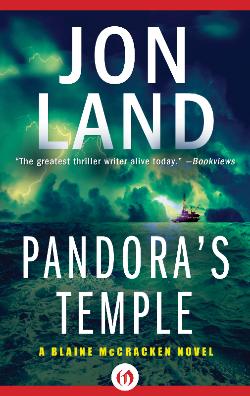
Pandora_Cover_Lg55b7c2Buckle-up! Hold Tight! Pandora’s Temple is one hell of a ride.

If you’re looking for a thriller with a break-neck pace then this could be the book for you. It has everything from unexplained natural phenomena to giant undersea creatures; and megalomaniac industrialists to suicidal Japanese fanatics. There are even some eco-terrorists and crazy gun-toting robots thrown in for good measure.

Blaine McCracken is the hero of this story; he’s a former Special Forces commando, who’s once again answering his country’s call to help. He carries a sense of vulnerability from a previous mission that wasn’t totally successful but is basically a strong, sound character, who with the other principle characters paints the believable cast. I particularly liked Wareagle, and the just plain crazy, Captain Seven who complimented their fellow adventurers.

At times, some of the action pushed the believability threshold a little, but the author kept things within the realms of possibility and scientific fact without going too far. The action when it came was swift and credible, and felt authentic; with good attention to detail where it mattered.

There are plenty of Blaine McCracken adventures to read, but this one stands alone well, and there’s enough detail that means you don’t need to read them in order and can easily start with this one if you wanted to.

Pandora’s Temple is an entertaining read, and perfect for when you need a book to let you escape your own world for a bit. Come and join Blaine McCracken and his companions on a non-stop adventure.

My Rating: 4 out of 5 Stars – I Really Liked It.

Special Giveaway:

The author has very kindly offered an e-book version of one of his previous novels The Omega Command. If you’d like a chance to win this, please leave a comment to this post below. Please state the e-book type you would like in your comment e.g. kindle, nook etc.

Thanks to Jon Land for his generosity.

PIC_badge

Two Years A Kindle Owner

I’ve had a Kindle for little over two years now.

I wondered when I bought it how it might affect my reading and book buying habits. Would I stop buying physical books and only buy Kindle books from now on? Would my kindle be just a flash in a pan though, and would I be unable to give up the allure of the physical book.

In truth after two years I think it’s none of the above. I think I have spent far more money on “books” than I might otherwise have done in the last two years, having regularly fallen for the temptation of the “Kindle Daily Deal” or other promotions; where I’ve bought books, many of which I still haven’t read. Then again I’ve bought books on promotion that I wouldn’t otherwise, and have enjoyed them and gone on to buy more by those authors.

I haven’t given up on physical books either, although I have probably changed my habits here. I tend to now only buy physical books that are by authors where I particularly want to keep a physical copy, or those that don’t produce a Kindle edition, for whatever reason.

I still visit bookshops too, although I will admit this is one source where I am definitely buying less books from, I’ve become much more of a browser now than I was before.

Overall I think my Kindle has had a positive impact. I’m reading more books than I ever have, and taking advantage of being able to carry my Kindle just about anywhere means I’ve made more time available to read.

I’m also impressed that it is as robust as it is. I did wonder whether it would last this long, but I’m pleased to say that it seems to be working as well today, as the first day I owned it. The battery life is still very good, taking weeks or even months between each charge, even with the Wi-Fi activated. It still has plenty of space for more books too, so no worries about storage space anytime in the near future.

All round a good investment.

Book Review: Proof of Guilt by Charles Todd

ProofofGuilt_banner

Synopsis

An unidentified body appears to have been run down by a motorcar and Ian Rutledge is leading the investigation to uncover what happened. While signs point to murder, vital questions remain. Who is the victim? And where, exactly, was he killed?

One small clue leads the Inspector to a firm built by two families, famous for producing and selling the world’s best Madeira wine. Lewis French, the current head of the English enterprise is missing. But is he the dead man? And do either his fiancée or his jilted former lover have anything to do with his disappearance—or possible death? What about his sister? Or the London office clerk? Is Matthew Traynor, French’s cousin and partner who heads the Madeira office, somehow involved?

The experienced Rutledge knows that suspicion and circumstantial evidence are not proof of guilt, and he’s going to keep digging for answers. But that perseverance will pit him against his supervisor, the new Acting Chief Superintendent. When Rutledge discovers a link to an incident in the family’s past, the superintendent dismisses it, claiming the information isn’t vital. He’s determined to place blame on one of French’s women despite Rutledge’s objections. Alone in a no man’s land rife with mystery and danger, Rutledge must tread very carefully, for someone has decided that he, too, must die so that cruel justice can take its course.

About the Author

Charles Todd is the author of the Inspector Ian Rutledge mysteries, the Bess Crawford mysteries, and two stand-alone novels. A mother and son writing team, they live in Delaware and North Carolina, respectively.

Excerpt

Chapter One

Funchal Harbor, Madeira 3 December 1916

He couldn’t remember, later, what had taken him down to the harbor.

Now, staring out at the masts of the CS Dacia, the British cable-laying ship, he found himself thinking about England.

Dacia was said to be diverting the overseas cable, in an attempt to deny the Germans access to it. Whether it was true or not, he didn’t know. But she and the French gunboat Surprise had brought the war home to him in an unexpected and unwelcome fashion.

England had been at war since August 1914. But Portugal and, by extension, Madeira had remained neutral in spite of a centuries’ old alliance with Britain. In spite, as well, of clashes with Germany in the Portuguese Colony of Angola, in Africa. Neutrality was one of the reasons he’d decided to live here. His grandmother had been a Quaker by conviction, and he himself held strong views about war and the waste it brought in its wake.

He turned to look upward. Madeira was volcanic, its climate temperate, and its soil fertile. A paradise of flowers, which his mother had loved. Clouds were beetling down the mountainside, concealing the heights, but on a promontory to the far side of the bay, he could still see the tower of his house. Three stories, like most in Funchal, and in his eyes far more handsome than the house where he’d grown up in Essex. It was his late grandfather Howard French, his mother’s father, who had introduced him to the wine business here. He’d come as a boy and stayed as a man. An exile, but a happy one.

A flash spun him around to stare at the harbor just as an explosion amidships sent a column of black smoke rising from Dacia. He was trying to think what could have happened aboard when another explosion rocked Surprise, and just above him, from the vantage point of the Grand Hotel grounds, someone was pointing and shouting.

“There—look, it’s a submarine!”

The voice carried clearly, this close to the water.

He didn’t lose time trying to see. He began to run, turning his back on the harbor as other explosions shook it. People were coming out of doorways, stopping in the streets to stare, calling to one another, unable to believe the evidence of their own eyes. He risked a glance over his shoulder and saw pillars of black smoke rising from Dacia, which had been hit again, and Surprise, and even Kangaroo, a third ship near them.

Someone in the water was screaming, and he could hear other cries as the heavy smell of burning timbers wafted inland on the onshore breeze, making him cough.

His offices were on the street just above the harbor. French, French & Traynor, Exporters, handled Madeira, the fortified wine that had made the island famous. And if this shelling of the ships in the harbor was a precursor to an invasion, there was work to be done in a hurry.

Sprinting across the street, where a few motorcars were halted, and several carriages and drays had pulled up, their occupants transfixed by the burning ships, he passed a wild-eyed horse rearing in its traces, the odor of smoke terrifying it.

In the doorway of the export house stood most of his employees, and those who couldn’t crowd into the narrow space were at the windows, their faces nearly as shocked as he felt. “

Mr. Traynor!” his foreman shouted in English. “What are they doing?”

“I don’t know.” He pushed his way inside and ordered his people to follow him.

His own office was in the front, overlooking the street. Behind the offices was the long space where the shop stood and the heavy drays were kept. Above and beyond that the cavernous rooms where great barrels of Madeira, coded by age and type, rested on their sides. And the high-ceilinged rooms with the kettles and vats and gauges that heated the wine, along with the smaller room where all the tools collected through centuries of winemaking were displayed. And at the very back, the long room where employees ate their meals, walls hand-painted by them down the generations and a source of much pride.

Wood, all of them, and they were all vulnerable to fire.

He stopped short, suddenly overwhelmed.

What to do? It would take days—and at best would be a very risky task—to move the wine, and as for the equipment, more days to disengage the pipes and lines that connected kettles to vats. An impossible task.

Even if he managed it, where could he take an entire building to safety?

Matthew Traynor stood there, feeling helpless.

Damn the Germans. And damn the war.

Someone was asking him if Portugal had been attacked—if it had fallen—if this was a prelude to invasion. Others were pleading with him to allow them to leave, to reach their families before it was too late.

Torn, feeling for the first time in his life that he didn’t know how to answer, he tried to collect his wits and act.

Just as he was about to speak, someone poked his head into the doorway behind Traynor and shouted, “The U-boat. She’s surfacing.”

He went to the door to see for himself, and there was the U-boat, in plain view, water still spilling across her hull, gun crews clambering out of the tower, racing across to the deck guns. The fort’s harbor batteries, such as they were, hadn’t opened up. By the time he looked back at the submarine, men had reached the guns, swung them around, and the shelling began.

Not of the harbor, but of Funchal itself.

He realized then that it was too late. “Go home. While you can,” he told the employees waiting anxiously behind him. “If this is an invasion, stay at home. Don’t do anything rash.”

“What about the wine?” his foreman asked. “What are we to do?”

Traynor took a deep breath. “We’ll just have to pray it survives. Now go, take the back streets. Hurry. No, not this way, out through the rear door.”

He could hear the shells exploding now, picture in his mind the damage being done, the cost in property and lives. People were screaming, running in every direction, panicked.

His secretary, a young Portuguese man he’d hired last year, was tugging at his sleeve. “Come, you must go too. Look how the shells are falling!”

And Matt Traynor let himself be led to his own rear door, his mind numbed by shock and a terrible anger he couldn’t control. Around him the building shuddered as a shell landed not more than three houses away.

Years of work. Years. And there was nothing he could do.

The shelling lasted all of two hours. The harbor guns, ineffectual at best, could do little to stop the ravaging of the capital. Runners had been sent to other towns on the island, asking if there had been landings of German troops, but no reports came back.

And then, as suddenly as it had begun, the shelling stopped. The submarine decks cleared, the hatch was closed, and she slipped quietly beneath the harbor waves, leaving behind two burning vessels, the Dacia already sunk, and countless lives lost. In the town itself, shells accounted for other deaths, falling masonry and timbers for more wounded and dying.

Matt Traynor, hurrying by horseback into Funchal again, saw to his utter amazement that the firm’s windows had been blown out, glazing everywhere, but the building was still standing and appeared to be sound. Still, there were the casks, the great barrels, and the shaking they must have sustained, seals broken, staves sprung. The new wine the vats held, which would either be all right or a total loss, nothing in between. Weeks would pass—months— before he learned what the cost of the shelling would actually be. And there were the glaziers, to replace the glass. They would be busy—he must contact them at once, today, to protect the building from looters come for the wine. Meanwhile, he must hire more night watchmen to stand guard until the House of French, French & Traynor was secure once more.

Dismounting, he stood there for a moment, staring around him at the destruction that had changed this familiar street into a nightmare, masonry everywhere, trees shattered, the pavement itself pocked and broken.

And then, taking a deep breath, he prepared himself for what he’d find inside.

Someone was running down the littered street, calling his name. It was a maid from the house of his fiancée. He felt his heart turn over. “What is it?” he shouted to Manuela and stood where he was, rooted to the spot.

“It’s the Senhorita,” she cried, and he wanted to cover his ears.

Please, God, nothing more. I can’t face anything more.

The bleeding of war-torn France, the endless lists of dead, wounded, and missing from Ypres and the Somme, the suffering in England—none of these had touched him. But this was different. This was his own safe, happy world.

“She’s dead,” Manuela was saying, tears streaming down her red face, and he could read her lips even though the words refused to register. “The beam in her bedroom—she was praying before the Madonna, and it—She’s dead.”

He heard himself say, “But—that’s not possible. Her house was out of range, it was safe.”

“It was the shaking, Senhor. It went on and on, and the plaster gave way..”

A week later, his affairs set in order, his fiancée and her mother buried in the hillside cemetery where scarlet bougainvillea spilled luxuriantly over the wall, a brightness that hurt the eyes, he set sail for Portugal. To enlist there.


My Review

proofofguiltA procedural with a historical setting sees Inspector Ian Rutledge of Scotland Yard investigating a death in unusual circumstances and a disappearance. All is not as it seems as Inspector Rutledge investigates.

I’m a great fan of modern police procedurals, and this was a departure from my normal tastes. The book remains faithful to its historical setting and as such elements of the procedural content take much longer than they might now, there are no mobile phones or computers, but the author ensures that he keeps the reader’s attention focussed on the story and the investigation.

The mysterious nature and suspense is maintained throughout the story with little pieces being revealed to the reader paying close attention, but otherwise key parts of the plot come with a sudden bang.

I liked the characters; they seemed true to themselves and to the period setting, with minor characters such as servants playing a role to add authenticity to the story. I personally disliked the character of Hamish (I don’t want to say too much here as that will spoil an element of the story), because I found him annoying, however he was quite fundamental to telling some of the story and to helping Rutledge reach his investigative conclusions. By the end of the book he was tolerable, but I wish the author had found another way to tell this part of the story.

I found the constant driving of Rutledge in his “motorcar”, to be a bit wearing. It was a necessary evil due to period setting of the story, but again I think the author could have found another way to cover this without constant reference to the ‘car.

If you’re a fan of the police procedural, you might enjoy this story; I think you’re more likely to enjoy it, if you’re a fan of historical stories and like a good mystery thrown in for good measure.

My Rating: 3 out of 5 stars – I Liked It

PIC_badge