Origins

Wilson

I was born on 28th March 2010, at Netley Marsh in Hampshire. I’m a mongrel, or so my paperwork says. That means that my parents were two different breeds of dog.

My mum was a Border Collie, and my dad, a Jack Russell Terrier.

Alan says that I take after my mum for my colouring – black and white – and after my dad for my size.

Alan said from the first day that I came home with him that I would probably take after both my parents for my temperament – smart but stubborn.

Continue reading “Origins”

Rose Garden

Spent this morning clearing a wall in our garden to make way for some climbing roses.
Garden Wall
Looks pretty uninteresting at the moment, but hopefully it will soon become a bit more colourful.

Roses (bareroot) have been ordered  – Tess of the d’Urbervilles (Red) & The Generous Gardener (White).

Need to do a bit to the border in terms of some compost and also something along the wall for the roses to be able to climb up and be tied off to. This will be a bit of an ongoing project for a few weeks, but will hopefully result in colour and fragrance on that side of the garden in due course.

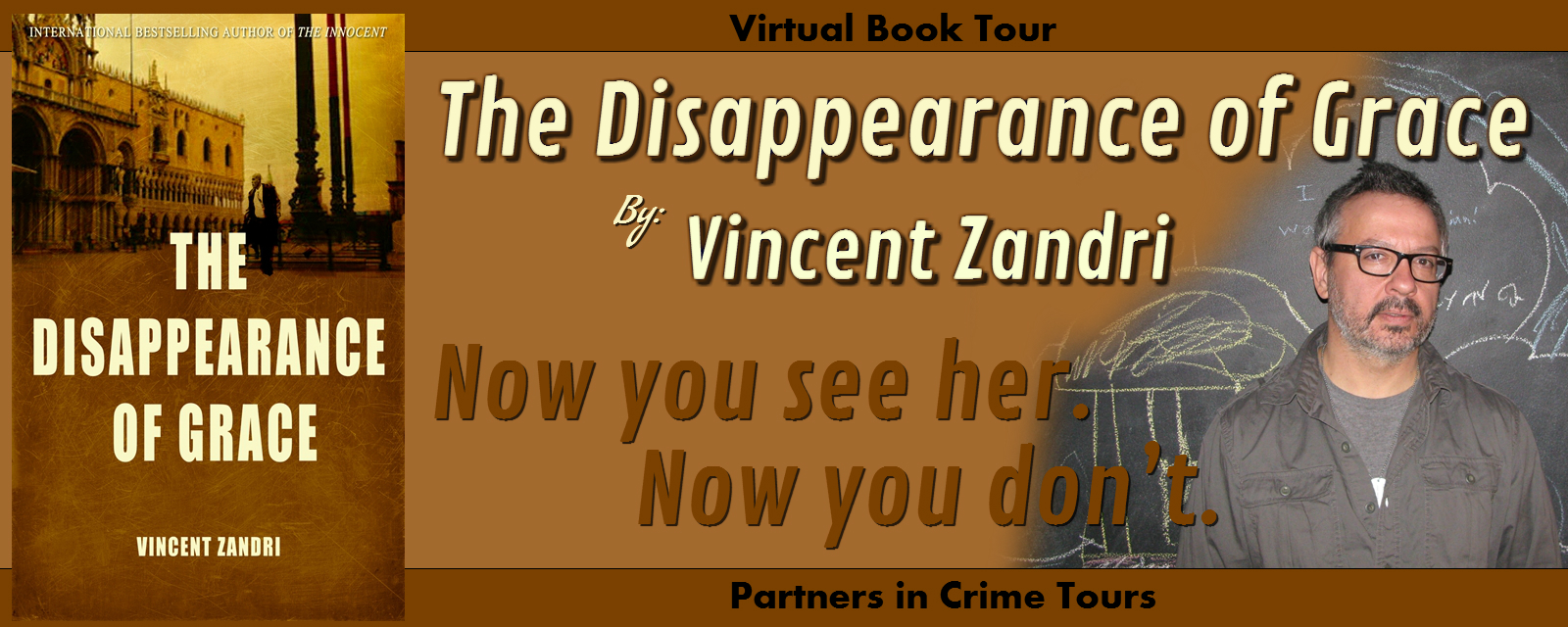
Guest Post: Vincent Zandri author of The Disappearance of Grace

FINAL_Grace_3authorpicbylauraMy guest today is Vincent Zandri, author of the Disappearance of Grace, as well as a number of other thrillers including the standalone Concrete Pearl and the Dick Moonlight series. I had a few questions for him about his latest book and also what his up and coming plans are. Here’s what he had to say:


Q: You really nailed Venice for the reader with the detail in The Disappearance of Grace. Did you decide to use the City before your recent visit or as a result of it? Was there somewhere else in mind? You’re also currently in Egypt, can we expect to be reading a book set there in the near future?

I’ve been lucky enough to visit Venice a few times over the past twenty years. Once during Carnival which is its own unique, dream-like experience. It’s such a mysterious maze of narrow alleys and stone walkways that actually light up in the rain. On occasion, those paths lead to nowhere but water. You can’t help but get lost. You also want to get lost. Or, you should anyway. Navigating Venice is kind of like walking a forest in that what you see when walking one direction doesn’t always resemble what you see when walking in the opposite direction. Venice creates wonder and awe in the people who see her for the first time. But it just might be one of the most beautiful places on earth that also causes great fear. Out of my own anxiety I wondered how it would feel to lose someone you loved very much in a city of water, love, art, and mystery.

 Yes, I’m in Egypt researching a new project called CHASE which will initially be a Kindle series for Thomas & Mercer, and then a book. It’s possible Egypt will be included in a future stand-alone novel as well.

Q: Your principal character suffers from a form of Post-Traumatic Stress Disorder, which you managed to make very real for the reader. How did you research this and was there anything in particular you were able to use to make it feel so real for the reader?

I did some research, academically speaking. But mostly I talked to real people who have suffered PTSD under various circumstances. I come from a long line of combat infantry soldiers so I was able to witness the effects of prolonged combat to a certain degree. Years ago many of my friends were Viet Nam vets who underwent some horrible combat situations which mimic much of what happens in the Afghanistan portion of the novel. Sadly, most of the vets are dead now, having died early from self-medicated the malevolent effects of the PTSD. Even today, I make a point of listening to the stories of soldiers currently fighting in Afghanistan or who have fought in Iraq. I also meet many of them on my travels.   

Q: I felt that Grace was a bit of an enigma for a large part of the book, meaning that I was never quite sure what her fate had been and why she had disappeared. Was this intentional on your part or just a lucky coincidence?

Absolutely intentional.  Without spoiling, I wanted to create the effect of viewing this story entirely through the eyes and mind of Nick. In doing so it’s possible the reader might actually consider Grace a figment of his imagination. Part of the PTSD. Her name is not coincidental either. She is more than a woman to Nick. She is a state of being, and a necessary part of who he is as a complete, but damaged, human being.

Q: Over the last year, you’ve signed some major deals with publishers and we’re starting to see some of your earliest books being republished. What are your plans for the next year in terms of new books, or are we going to have to wait and see?

In two weeks my next major book, Murder by Moonlight will be released by Thomas & Mercer of Amazon Publishing. A few months after that, Moonlight Sonata will also be released. The third in the Marconi series is also coming. It’s called The Guilty. Just now I’m beginning to outline a stand-alone called, The Ashes. Also, I’ll be working on the new series CHASE which will probably see the light of day in early 2014. So, yes, lots on the fire.

Book Review: The Disappearance of Grace by Vincent Zandri

SYNOPSIS:

Now you see her. Now you don’t…

Captain Nick Angel has finally made a separate peace with the war in Afghanistan. Since having been ordered to bomb a Tajik village which resulted in the death of a little boy of no more than two, he’s been suffering from temporary bouts of blindness. Knowing the he needs time to rest and recover from his post traumatic stress, the US Army decides to send him to Venice along with his fiancee, the artist, Grace Blunt. Together they try and recapture their former life together. But when Grace suddenly goes missing, Nick not only finds himself suddenly alone and sightless in the ancient city of water, but also the number one suspect in her disappearance.

A novel that projects Hitchcockian suspense onto a backdrop of love and war, The Disappearance of Grace is a rich, literary thriller of fear, loss, love, and revenge. From the war in the Afghan mountains to the canals of romantic Venice, this is a story that proves 20/20 eyesight might not always be so perfect and seeing is not always believing.

About the Author:

Vincent Zandri is the No. 1 International Bestselling Amazon author of THE INNOCENT, GODCHILD, THE REMAINS, MOONLIGHT FALLS, CONCRETE PEARL, MOONLIGHT RISES, SCREAM CATCHER, BLUE MOONLIGHT and MURDER BY MOONLIGHT. He is also the author of the Amazon bestselling digital shorts, PATHOLOGICAL, TRUE STORIES and MOONLIGHT MAFIA. Harlan Coben has described THE INNOCENT (formerly As Catch Can) as “…gritty, fast-paced, lyrical and haunting,” while the New York Post called it “Sensational…Masterful…Brilliant!” Zandri’s list of publishers include Delacorte, Dell, StoneHouse Ink, StoneGate Ink and Thomas & Mercer. An MFA in Writing graduate of Vermont College, Zandri’s work is translated into many languages including the Dutch, Russian, and Japanese. An adventurer, foreign correspondent, and freelance photo-journalist for RT, Globalspec, IBTimes and more, he lives in Albany, New York.

Website Facebook Twitter

Excerpt:

The wind picks up off the basin.
It seems to seep right through my leather coat into flesh, skin and bone. I try and hold my face up to the sun while the waiter takes our orders. Grace orders a single glass of vino russo and a pancetta and cheese panini. I forgo the Valpolicella and order a Moretti beer and a simple spaghetti pomadoro. The waiter thanks us and I listen to him leaving us for now.We sit in the calm of the early afternoon, the sounds of the boat traffic coming and going on the basin filling my ears. People surround us on all sides. Tourists who have come to San Marco for the first time and who’ve become mesmerized by it all. I don’t have to physically see them to know how they feel. The stone square, the Cathedral, the bell tower, the many shops and high- end eateries that occupy the wide, square-shaped perimeter. The pigeons. The people. Always the throngs of people coming and going amidst a chorus of bells, bellowing voices, live music emerging from trumpets, violins, and guitars, and an energetic buzz that seems to radiate up from underneath all that stone and sea-soaked soil.It’s early November.Here’s what I know about Venice: In just a few week’s’ time, the rains will come and this square will be underwater. The ever sinking Venice floods easily now. The only way to walk the square will be over hastily constructed platforms made from cobbled narrow planks. Many of the tourists will stay away and the live music will be silenced. But somehow, that’s when Venice will come alive more than ever. When the stone is bathed in water.

The waiter brings our drinks and food.
With the aroma of the hot spaghetti filling my senses, I dig in and spoon up a mouthful. I wash the hot, tangy sauce-covered pasta down with a swallow of red wine.

“Whoa, slow down, chief,” Grace giggles.

“Eating, smiling, making love to me. What’s next? Writing?”

“Don’t press your luck, Gracie,” I say. “The sea change can occur at any moment. Just don’t start asking me to identify engagement rings.”

She laughs genuinely and I listen to the sounds of her taking a bite out of her sandwich. But then she goes quiet again. Too quiet, as if she’s stopped breathing altogether.

“There’s someone staring at us,” she says under her breath.

“Man or woman?” I say, trying to position my gaze directly across the table at her, but making out nothing more than her black silhouette framed against the brightness of the sun. Later on, when the sun goes down, the image of her will be entirely black. Like the blackness of the Afghan Tajik country when the fires are put out and you lie very still inside your tent without the benefit of electronic night vision, and you feel the beating of your never- still heart and you pray for morning.

“Man,” she whispers.

“What’s he look like?”

“It’s him again. The man in the overcoat who was staring at us yesterday.”

A start in my heart. I put my fork down inside my bowl. “Are you sure?”

“Yes. I think. He’s wearing sunglasses this time. So,. I think it’s him.”

“What’s he look like?”

“He’s a thin man. Not tall. Not short. He’s got a dark complexion.”

“Black?”

“No. More like Asian or Middle Eastern. He’s wearing sunglasses and that same brown overcoat and a scarf. His hair is black and cut close to his scalp. His beard is very trim and cropped close to his face.” She exhales. I hear her take a quick, nervous sip of her wine. “He keeps staring at us. At me. Just like yesterday, Nick.”

“How do you know he’s staring at you? It could be something behind you, Grace. We’re in Venice. Lots going on behind you. Lots to see.”

She’s stirring in her chair. Agitated.
“Because I can feel him. His eyes…I. Feel. His. Eyes.”

I wipe my mouth clean with the cloth napkin. I do something entirely silly. I turn around in my chair to get a look at the man. As if I have the ability to see him right now, which I most definitely do not.

“What are you doing?” Grace poses, the anxiety in her voice growing more intense with each passing second.

“Trying to get a look at him.”

“You’re joking, Nick.”

I turn back, try and focus on her.

“You think?”

We sit silent.
Once more I am helpless and impotent.

“I’m sorry,” she says after a time. “I’m not trying to insult you. This isn’t like yesterday with the ring. But this man is at the same café we’re at two days in a row? This is really starting to creep me out, babe.”

My pulse begins to pump inside my head. Not rapid, but just enough for me to notice. Two steady drum beats against my temples. I find myself wanting to swallow, but my mouth has gone dry. I take a sip of beer thinking it will help.

“He’s coming towards us, Nick. I don’t like it.”

Heart beat picks up. I feel it pounding inside my head and my chest.

“Are you sure he’s coming towards us, Grace?” I’m trying not to raise my voice, but it’s next to impossible.

“He’s looking right at me. His hands are stuffed in the pockets of his overcoat. And he’s coming.”

I feel and hear Grace pulling away from the table. She’s standing. That’s when the smell of incense sweeps over me. A rich, organic, incense-like smell.

There comes the sound of Grace standing. Abruptly standing. I hear her metal chair push out. I hear the sound of her boot heels on the cobbles. I hear the chair legs scraping against the stone slate. I hear the sound of her wine glass spilling.

“Grace, for God’s sakes, be careful.”

But she doesn’t respond to me. Or is it possible her voice is drowned out by what sounds like a tour group passing by the table? A tour group of Japanese speaking people. But once they pass, there is nothing. No sound at all other than the boats on the basin and the constant murmur of the thousands of tourists that fill this ancient square.

“Grace,” I say. “Grace. Stop it. This isn’t funny. Grace.”

But there’s still no response.
The smell of incense is gone now.
I make out the gulls flying over the tables, the birds shooting in from the basin to pick up scraps of food and then, like thieves in the night, shooting back out over the water. I can hear and feel the sound-wave driven music that reverberates against the stone cathedral.

“Grace,” I repeat, voice louder now. “Grace. Grace…Grace!”

I’m getting no response.

It’s like she’s gone. Vanished. But how can she be gone? She was just sitting here with me. She was sitting directly across from me, eating a sandwich and drinking a glass of wine. She was talking with me.
The waiter approaches.

“The signora is not liking her food?” he questions.

I reach out across the table. In the place where she was sitting. She is definitely not there.

“Is there a toilet close by?” I pose. “Did you see my fiancée leave the table and go to the toilet?”

The waiter pauses for a moment.

“I am sorry. But I did not. I was inside the café.”

“Then maybe somebody else saw her. Maybe you can ask them.”

“Signor, there are many tables in this café and they are all filled with people. And there are many people who walk amongst the tables who can block their view. I am looking at them. No one seems to be concerned about anything. Sometimes there are so many people here, it is easy to get lost. Perhaps she just went to the toilet like you just suggested, and she got lost amongst the people. I will come back in moment and make sure all is well.”

I listen to the waiter leaving, his footsteps fading against the slate.
Grace didn’t say anything about going to the toilet or anywhere else. Grace was frightened. She was frightened of a man who was staring at her. A man with sunglasses on and a cropped beard and a long brown overcoat. He was the man from yesterday. The man with black eyes. He was approaching us, this man. He came to our table and he smelled strongly of incense. He came to our table. There was a slight commotion, the spilling of a glass, the knocking over of a chair, and then Grace was gone.

I sit and stare at nothing. My heart is pounding so fast I think it will cease at any moment. What I have in the place of vision is a blank wall of blurry illumination no longer filled with the silhouette of my Grace.

I push out my chair. Stand. My legs knock into the table and my glass spills along with Grace’s.

I cup my hands around my mouth.

“Grace!” I shout. “Grace! Grace!”

The people who surround me all grow quiet as I scream over them.

The waiter comes running back over.

“Please, please,” he says to me, taking me by the arm. “Please come with me.”

He begins leading me through the throng of tables and people. He is what I have now in the place of Grace. He is my sight.

“She’s gone, isn’t she?” I beg. “Did you check the toilets?”

“We checked the toilets. They are empty. I am sorry. I am sure there is an explanation.”

“Grace is gone!” I shout. “A man took her away. How could no one have seen it?”

“You’re frightening the patrons, signor. Please just come with me and we will try and find her.”

“She’s gone,” I repeat. “Don’t you understand me? My. Grace. Is. Gone.”

My Review:

This one has it all. Strong characters, human interest, action, emotion, pace and a cracking story location.

From the hills of Afghanistan to the canals and alleyways of Venice, an unlikely combination and one which perhaps only a few authors could pull off, but Vincent Zandri has certainly done that here. The level of detail in the setting, places you at the heart of the scene each and every time. You can actually picture in your mind’s eye what’s going on and the backdrop to it.

The same is true of the characters; the book is not a particularly long one, but even in such a short space, the main character is laid out in detail so that you really get into his head from early in the book, which is what makes it work so well. On the other hand ‘Grace’ is more of a mystery to the reader and I think this adds to the centre of the plot in terms of what actually happened until this is revealed later in the book.

I’ve already said that this wasn’t a particularly long book, but it didn’t need to be, and could easily be read in one sitting. Again this makes the book ‘work’, as you turn the pages each chapter hooks you in more than the last and keeps you going until the end.

I have read a number of Mr Zandri’s books in the last couple of years, and whilst I would describe him as a thriller writer in the main, each time he manages to surprise me with a little something. Either a strong character or a detailed location, each book has an edge that makes it a page turner. With The Disappearance of Grace, Vincent Zandri has once again hit that sweet-spot, and if you haven’t already sought him out, it’s about time you did.

My Rating: 5 out of 5 Stars – I Loved It!

Guest Post: Ethan Cross, Author of “The Prophet”


My guest on the blog today is Ethan Cross, author of The Prophet. I asked Ethan:

“Serial killers seem to capture the readers imagination. Why do you think this is? A morbid fascination, seeking a thrill-ride or is it something else?”

Here’s what he had to say:


Serial killers are like aliens among us. They think and act in ways that most

of us cannot begin to comprehend, which in turn makes them fascinating. When we
turn on the news and see headlines describing the deeds of a serial killer, we
immediately wonder “How could a human being do something like that?” and “What
drove him over the edge?” When trying to unravel these mysteries, investigators
often look to the person’s past. They search for an event or series of events
that led this seemingly normal person to their ultimate fall from the realm of
the socially acceptable into the world of the criminally insane. But then, we
wonder if there is more at work behind these actions than a traumatic childhood
or series of bad experiences. Was this person born broken? Are they evil?
Most researchers accept that the deviant behavior of serial killers is a
combination of many factors. When questioned about nature vs nurture, one
psychologist asked, “Which contributes more to the area of a rectangle, its
length or its width?” And yet, there is no simple answer, and some maintain
that the circumstances into which a person is born determines their personality.

In my novels, The Shepherd and The Prophet, I touch upon the concept of nature
vs nurture as I place the reader into the mind of a twisted psychopath named
Francis Ackerman. Ackerman’s father was a psychologist who wanted to prove that
he could create a monster by subjecting his seemingly normal son to every known
traumatic event that had occurred in the lives of modern day serial killers.
His thinking is obviously flawed because by trying to prove his theories, he
establishes that there must be something broken within himself that he could
have passed onto his son, giving credence to the very concept he set out to
disprove. While this is only a small piece in the grand tapestry of the novel,
it’s still an important factor in understanding the twisted thoughts and
character of a man like Ackerman.

In a study conducted by the FBI, researchers found that 74% of the killers
surveyed experienced some type of abuse, whether physical or psychological,
during their childhood. 43% reported that they experienced sexual abuse
firsthand. The abused child growing up to become a serial killer has become a
cliche within our society, and yet there is a definite link between abuse at a
young age and violent behavior later in life. However, the fact remains that
most people who were abused as a child don’t grow up to become Ted Bundy, and
there are many killers that had a normal childhood. So, while abuse and
circumstance is definitely a factor, there must be more behind the madness.

We like to think that we are the masters of our own fate, but the truth is that
much of who we are was determined before we spoke our first word or even took
our first breath. The intricate make-up of our genes had already laid out a
certain path before us. We can overcome this and change our fate, but that
doesn’t negate the fact that certain barriers or advantages exist from the
moment of our births. A five-foot-four man can play professional basketball,
but he has a much greater barrier than someone born to be seven-foot-one. And
beyond the physical characteristics, there are certain mannerisms and behaviors
that we seem to inherit as well. Since my daughter was a tiny baby, she has
tucked her thumb into her palm and held it with the rest of her fingers. The
gesture seemed strange to me at first, until I realized that I do that
constantly. She obviously didn’t learn this behavior from me, and it’s
fascinating to think that such a small action could be coded within her genetic
sequence. It stands to reason that a person could be born with an inherited
pre-disposition to violent behavior, but is there even more than genetics and
circumstance at work?

There are also certain religious or philosophical issues to consider. Is there
an evil or negative force at work in the universe beyond what we can see and
easily quantify? These factors are often dismissed by the psychiatric
community, but since most of us believe in some sort of higher power, we can’t
help but wonder at the existence of evil. Although this is an area that is even
more difficult to study and classify, I believe it’s where the true key to
deviant behavior may be found. I believe that all serial killers, regardless of
varying circumstance and genetics, share one common trait. They all harbor a
darkness inside themselves, a darkness that shines through in their terrible
deeds. But the truly scary thing is that I believe we all carry this darkness
or capacity for evil to some degree, and this is where genetics, knowledge, and
the events of our pasts come into play. These factors contribute to our ability
to hold the darkness at bay. We’ve all learned from a very young age how to
manage our impulses. Otherwise, we would allow that sudden animal instinct of
anger or lust to elevate into rape or murder and our society would quickly
crumble.

I’ve always found this concept of darkness and the questions that go along with
it to be fascinating. Can the worst killer overcome the darkness and find some
form of redemption? Can they learn to control the darkness despite the barriers
working against them? What happens to a good man who embraces the darkness with
the best of intentions and under a banner of righteousness? It’s these
concepts, along with others, that I explore within the pages of my novels.

Book Review: The Prophet by Ethan Cross

Synopsis: 

OLD ENEMIES…
Francis Ackerman Jr. is one of America’s most prolific serial killers. Having kept a low profile for the past year, he is ready to return to work – and he’s more brutal, cunning, and dangerous than ever.

NEW THREATS…
Scarred from their past battles, Special Agent Marcus Williams cannot shake Ackerman from his mind. But now Marcus must focus on catching the Anarchist, a new killer who drugs and kidnaps women before burning them alive.

HIDDEN TERRORS…
Marcus knows the Anarchist will strike again soon. And Ackerman is still free. But worse than this is a mysterious figure, unknown to the authorities, who controls the actions of the Anarchist and many like him. He is the Prophet – and his plans are more terrible than even his own disciples can imagine.

With attacks coming from every side, Marcus faces a race against time to save the lives of a group of innocent people chosen as sacrifices in the Prophet’s final dark ritual.


About the author:

When a fireman or a policeman would visit his school, most of his classmates’ heads would swim with aspirations of growing up and catching bad guys or saving someone from a blazing inferno. When these moments came for Ethan Cross, however, his dreams weren’t to someday be a cop or put out fires; he just wanted to write about it. His dream of telling stories on a grand scale came to fruition with the release of his first novel, the international bestseller, THE SHEPHERD.

Ethan Cross is the pen name of a thriller author living and writ- ing in Illinois with his wife, two daughters, and two Shih Tzus. In addition to The Shepherd and The Prophet, he has published two novellas––The Cage and Callsign: Knight (with Jeremy Robinson).

WebsiteFaceBookTwitter

Excerpt:

CHAPTER ONE

Francis Ackerman Jr. stared out the window of the dark copper and white bungalow on Macarthur Boulevard. Across the street, a green sign with yellow letters read Mosswood Playground – Oakland Recreation Department. Children laughed and played while mothers and fathers pushed swings and sat on benches reading paperback novels or fiddling with cell phones. He had never experienced such things as a child. The only games his father ever played were the kind that scarred the body and soul. He had never been nurtured; he had never been loved. But he had come to accept that. He had found purpose and meaning born from the pain and chaos that had consumed his life.

He watched the sun reflect off all the smiling faces and imagined how different the scene would be if the sun suddenly burned out and fell from the heavens. The cleansing cold of an everlasting winter would sweep across the land, cleansing it, purifying it. He pictured the faces forever etched in torment, their screams silent, and their eyes like two crystal balls reflecting what lay beyond death.

He let out a long sigh. It would be beautiful. He wondered if normal people ever thought of such things. He wondered if they ever found beauty in death.

Ackerman turned back to the three people bound to chairs in the room behind him. The first two were men—plain-clothes cops that had been watching the house. The older officer had a pencil-thin mustache and thinning brown hair while his younger counterpart’s head was topped with a greasy mop of dark black. The younger man’s bushy eyebrows matched his hair, and a hooked nose sat above thin pink lips and a recessed chin. The first man struck Ackerman to be like any other cop he had met, honest and hard-working. But there was something about the younger man he didn’t like, something in his eyes. He suppressed the urge to smack the condescending little snarl from the younger cop’s ferret-like face.

But instead of hitting him, Ackerman just smiled at the cop. He needed a demonstration to get the information he needed, and the ferret would be perfect. His eyes held the ferret’s gaze a moment longer, and then he winked and turned to the last of his three captives.

Rosemary Phillips wore a faded Oakland Raiders sweatshirt. She had salt and pepper hair, and ancient pock marks marred her smooth dark chocolate complexion. Her eyes burned with a self-assurance and inner strength that Ackerman respected.

Unfortunately, he needed to find her grandson, and if necessary, he would kill all three of them to accomplish his goal.

He reached up to her mouth and pulled down the gag. She didn’t scream. “Hello, Rosemary. I apologize that I didn’t properly introduce myself earlier when I tied you up, but my name is Francis Ackerman Jr. Have you ever heard of me?”

Rosemary met his gaze. “I’ve seen you on television. You’re the serial killer whose father experimented on him as a child, trying to prove that he could create a monster. I guess he succeeded. But I’m not afraid of you.”

Ackerman smiled. “That’s wonderful. It means that I can skip the introductions and get straight to the point. Do you know why I asked these two gentleman to join us?”

Rosemary’s head swiveled toward the two officers. Her gaze lingered on the ferret. Ackerman saw disgust in her eyes. Apparently, she didn’t like him either. That would make things even more interesting once he started to torture the young cop.

“I’ve seen these two around,” she said. “I’ve already told the cops that my grandson ain’t no damn fool. He wouldn’t just show up here, and I haven’t heard from him since this mess started. But they wouldn’t listen. Apparently they think it’s a good idea to stake out an old lady’s house instead of being out there on the streets doing what the people of this city pay them to do. Typical government at work.”

Ackerman smiled. “I know exactly what you mean. I’ve never had much respect for authority. But you see, I’m looking for your grandson as well. I, however, don’t have the time or patience to sit around here on the off chance that he might show up. I prefer the direct approach, and so I’m going to ask you to level with me. Where can I find your grandson?”

“Like I told them, I have no idea.”

He walked over to a tall, mahogany hutch resting against the wall. It was old and well-built. Family pictures lined its surface and shelves. He picked up a picture of a smiling young black man with his arm around Rosemary. A blue and gold birthday cake sat in front of them. “Rosemary, I’ve done my homework, and I’ve learned that your grandson thinks the world of you. You were his anchor in the storm. Maybe the one good thing in his life. The one person who loved him. You know where he’s hiding, and you are going to share that information with me. One way or another.”

“Why do you even care? What’s he to you?”

“He’s nothing to me. I could care less about your grandson. But someone that I do care about is looking for him, and I try to be useful where I can. And like you said, sometimes bureaucracy and red tape are just too damn slow. We’re going to speed along the process.”

Rosemary shook her head and tugged on the ropes. “I don’t know where he is, and if I did, I’d never tell a monster like you.”

His father’s words tumbled through his mind.

You’re a monster…Kill her and the pain will stop…No one will ever love you…

“Oh, my dear, words hurt. But you’re right. I am a monster.”

Ackerman grabbed a duffle bag from the floor and tossed it onto a small end table. As he unzipped the bag and rifled through the contents, he said, “Are you familiar with the Spanish Inquisition? I’ve been reading a lot about it lately. It’s a fascinating period of history. The Inquisition was basically a tribunal established by Catholic monarchs Ferdinand II of Aragon and Isabella I of Castile in order to maintain Catholic orthodoxy within their kingdoms, especially among the new converts from Judaism and Islam. But that’s not what fascinates me. What fascinates me are the unspeakable acts of barbarism and torture that were carried out in the name of God upon those deemed to be heretics. We think that we live in a brutal age, but our memories are very short-sighted. Any true student of history can tell you that this is the age of enlightenment compared to other periods throughout time. The things the inquisitors did to wrench confessions from their victims was nothing less than extraordinary. Those inquisitors displayed fabulous imagination.”

Ackerman brought a strange device up out of the duffle bag. “This is an antique. It’s previous owner claimed that it’s an exact replica of one used during the Inquisition. You’ve got to love Ebay.”

He held up the device—built from two large, spiked blocks of wood connected by two threaded metal rods an inch in diameter each—for their inspection. “This was referred to as the Knee Splitter. Although it was used on more than just knees. When the inquisitor would turn these screws, the two blocks would push closer together and the spikes would first pierce the flesh of the victim. Then the inquisitor would continue to twist the screws tighter and tighter until they received the answers they wanted or until the affected appendage was rendered useless.”

Rosemary spit at him. As she spoke, her words were strong and confident. He detected a slight hint of a Georgian accent and suspected that it was from her youth and only presented itself when she was especially flustered. “You’re going to kill us anyway. No matter what I do. I can’t save these men anymore than I can save myself. The only thing that I can control is the way that I go out. And I won’t grovel and beg to the likes of you. I won’t give you the satisfaction.”

He nodded. “I respect that. So many people blame the world or society or others for the way that they are. But we’re all victims of circumstance to a certain extent. We like to think that we’re in control of our own destinies, but the truth is that much of our lives are dictated by forces far beyond our control and comprehension. We all have our strings pulled by someone or something. It’s unavoidable. The only place that we have any real control is right here.” He tapped the tip of his fifteen-inch survival knife against his right temple. “Within our minds. Most people don’t understand that, but you do. I didn’t come here to kill you, Rosemary. It will give me no pleasure to remove you from the world. But my strings get pulled just like everyone else’s. In this case, circumstances dictate that I hurt you and these men in order to achieve my goal. I’m good at what I do, my dear. I’ve been schooled in pain and suffering my entire life. Time will only allow me to share a small portion of my expertise with you, but I can tell you that it will be enough. You will tell me. That’s beyond your control. The only aspect of this situation that you can influence is the duration of the suffering you must endure. So I’ll ask again, where is your grandson?”

Her lips trembled, but she didn’t speak.

The smell of cinnamon permeated the air but was unable to mask a feral aroma of sweat and fear. Ackerman had missed that smell. He had missed the fear, the power. But he needed to keep himself contained. He couldn’t lose control. This was about information, not about satisfying his own hunger.

“Time to begin. As they say, I’m going to put the screws to this officer. Makes you wonder if this device is responsible for such a saying, doesn’t it?”

~~*~~

After several moments of enjoyment with his new toy, Ackerman looked at Rosemary, but she had diverted her gaze. He twisted the handles again, and the officer’s thrashing increased.

“Okay, I’ll tell you!” she said. “He’s in Spokane, Washington. They’re set up in an abandoned metal working shop of some kind. Some crooked realtor set it up for them. I’ve tried to get him to turn himself in. I even consider calling the police myself, but I know that he and his friends won’t allow themselves to be captured alive. He’s the only family I have left.” Tears ran down her cheeks.

Ackerman reached down and twisted the pressure from the officer’s legs. The man’s head fell back against the chair. “Thank you. I believe you, and I appreciate your situation. Your grandson has been a bad boy. But he’s your flesh and blood, and you still love him.”

He walked over to the table and pulled up another chair in front of Rosemary. As he sat, he pulled out a small notepad. It was spiral-bound from the top with a blood red cover. “Since you’ve been so forthcoming with me and out of respect, I’ll give you a genuine chance to save your lives.” He flipped up the notepad’s cover, retrieved a small pen from within the spiral, and started to write. As the pen traveled over the page, he said, “I’m going to let you pick the outcome of our little game. On this first sheet, I’ve written ‘ferret’ to represent our first officer.” He tore off the page, wadded it up, and placed it between his legs. “On the second, we’ll write ‘Jackie Gleason’ to represent the next officer. Then Rosemary. Then all live. And all die.”

He stirred up the wadded pieces of paper and placed them on the floor in front of her. “I think the game is self-explanatory, but to make sure that there’s no confusion, you pick the piece of paper, and I kill whoever’s name is on it. But you do have a twenty percent chance that you all live. And just to be clear, if you refuse to pick or take too long, I’ll be happy to kill all three of you. So please don’t try to fight fate. The only thing you have control over here is which piece of paper you choose. Have no illusions that you have other options. It will only serve in making the situation even less manageable for you. Pick one.”

Rosemary’s eyes were full of hate. They burrowed into him. Her gaze didn’t waver. A doctor named Kendrick from the Cedar Mill Psychiatric Hospital had once told Ackerman that he had damage to a group of interconnected brain structures, known as the paralimbic system, that were involved in processing emotion, goal seeking, motivation, and self-control. The doctor had studied his brain using functional magnetic resonance imaging technology and had also found damage to an area known as the amygdala that generated emotions such as fear. Monkeys in the wild with damage to the amygdala had been known to walk right up to people or even predators. The doctor had said this explained why Ackerman didn’t feel fear in the way that other people did. He wondered if Rosemary had a similar impairment or if her strength originated from somewhere else entirely.

She looked down at the sheets of paper then back into his eyes. “Third one. The one right in the center.”

He reached down and uncrumpled the small piece of paper. He smiled. “It’s your lucky day. You all get to live. I’m sorry that you had to endure this due to the actions of someone else. But as I said, we’re all victims of circumstance.”

Then he stood, retrieved his things, and exited onto Macarthur Boulevard.

~~*~~

Ackerman tossed his duffle bag into the trunk of a light-blue Ford Focus. He wished he could travel in more style, but the ability to blend outweighed his own sense of flare. He pulled open the driver’s door, slipped inside, and dropped some jewelry and the wallets and purse of his former captives on the seat next to him. He hated to lower himself to common thievery, but everything cost money. And his skill set didn’t exactly look good on a resume. Besides, he didn’t have time for such things.

He retrieved a disposable cell phone from the glove box and activated the device. As he dialed and pressed send, he looked down at the small slip of paper that Rosemary had chosen. The words All Die stared back at him.

After a few rings, the call connected, and the voice on the other end said, “What do you want?”

Ackerman smiled. “Hello, Marcus. Please forgive me, for I have sinned. But I do it all for you.”

My Review:

If you’re looking for a thriller that doesn’t let up on the action and keeps you guessing at each turn of the page then, The Prophet could be for you.

The action comes thick and fast, with the main characters constantly finding themselves in situations calling for skill, intelligence and heroism. That’s not to say it’s all plain sailing for them, anything but.

Character development is good, and this is the second in a series. It does work as a stand-alone, but I did find myself wishing that I had read the first book in the series. Due to the number of characters at times I lost track of who was who and what they were doing, particularly when the action was coming so thick and fast.

The story was strong and believable. There were times when plausibility was stretched, but only slightly and it made the overall tale more believable. Some of the detail of the murders might put those of a weak-stomached disposition off a bit, but they’re not too gratuitous and bring home the horror of the crimes, and what is going on and how it is affecting some of the main characters.

I will be going back to the first book after reading The Prophet, not because I want to fill in the back story, but because this was a great book and I would like to read more by this author. Although not an author that I had heard of before being asked to review this book, he’s certainly one that I will be keeping my eye on from now on.

My Rating: 4 out of 5 Stars – I Really Liked It.